
5 min read

Topics on this page
Something is shifting in the German mid-market. Companies that might have turned to U.S. hyperscalers in recent years are now asking tougher questions: What will the three-year total cost of ownership really be? Where is the data actually stored and under whose legal jurisdiction? Who answers the phone when something goes wrong?
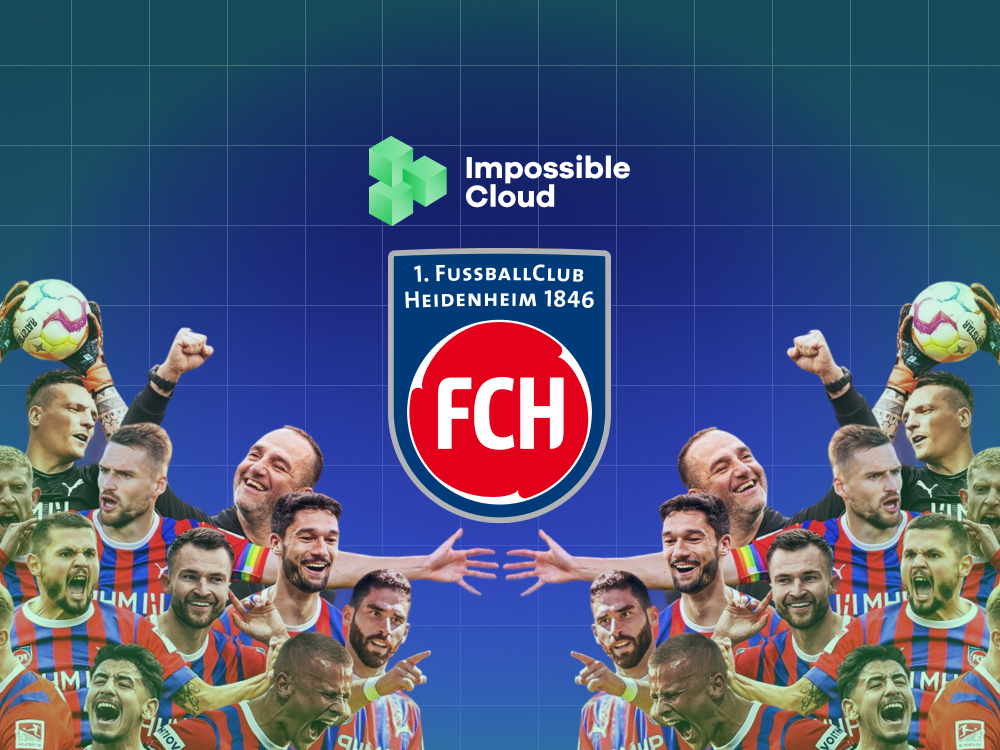
1. FC Heidenheim 1846 found its own answers to these questions. The club deliberately chose a German-based solution, prioritizing data sovereignty "Made in Germany."
Five years ago, the mid-market in Germany was focused on whether to move to the cloud at all. Today, the question is no longer if, but how: which cloud, under which conditions, in which country. And most importantly: how do we avoid a cloud bill at the end of the year that is twice as high as expected?
Mid-sized organizations are increasingly drawing conclusions from this. They do not necessarily stay with a provider just because migration would be inconvenient. They switch when costs, location, or service no longer fit. 1. FC Heidenheim 1846 is a case in point: after switching providers twice and refining its requirements along the way, the club found the right cloud storage partner in Impossible Cloud.
When you look more closely, the same three criteria appear again and again in mid-market cloud decisions. And they appear in an order that hyperscaler marketing teams may not like to hear.
First comes data residency. Not because of gut feeling, but because risk assessments, compliance requirements, and industry regulations demand clear answers. Second comes value for money, and that does not mean the list price, but total cost of ownership (TCO): what is actually billed after egress fees, API calls, and restore tests. Third, often underestimated, is personal contact: a direct point of contact who knows the environment, rather than a ticket in a global queue.
FCH operates its own data center and works with a system integrator partner. For backups, the club followed the 3-2-1 rule from the start: two local copies and one off-site copy. Yet that off-site copy remained the challenge for years.
The first attempt was a U.S. hyperscaler. It proved too expensive for ongoing operations, even with the preferential terms often available to German registered non-profit clubs. Next came a U.S. object storage provider. Technically, it worked well, but day-to-day management was cumbersome because storage buckets could only be created through partners.
The turning point came at a partner event hosted by the club's system integrator, where Heidenheim first came into contact with Impossible Cloud. While other German providers were also evaluated, Impossible Cloud stood out for its combination of German data residency, personal support, and highly competitive pricing model.
“We are very pleased to have won 1. FC Heidenheim 1846 as a customer and to support its infrastructure setup. Football, much like data protection, is a very emotional topic. We are glad that we can at least help with the latter,” says Daniel Arabié, VP Sales at Impossible Cloud.
"When we are asked where our data is stored, we can answer that question." This statement from the club's IT managers sounds simple, but in a risk assessment it is worth its weight in gold. Supervisory bodies, associations, and, in the club's case, the DFL expect documented answers, not just references to global availability zones.
For that answer to hold up, the underlying cloud setup has to be just as clear. With Impossible Cloud, FCH stores its data in German data centers, works with a European provider, and can rely on ISO 27001 certification as the formal foundation required in many risk matrices.
For FCH, this means less effort when dealing with auditors, insurers, and business partners. Data sovereignty becomes a verifiable fact rather than a marketing promise, and that makes a measurable difference in risk management.
With U.S. hyperscalers, the unpleasant costs often appear only during restore. Traffic fees, API calls, recovery tests: all of these show up on the invoice, often at a level that was not reflected in the original calculation.
For a backup strategy, it is fatal if every recovery test drives up costs. In practice, this often leads to important tests not being carried out at all.
With Impossible Cloud's model, which does not charge egress fees, restore tests become routine rather than a cost risk. This creates the necessary security and gives IT managers the freedom to focus on strategic tasks instead of micromanaging traffic fees.
For the IT department at 1. FC Heidenheim 1846, one thing is clear: "For a good price, you get a really good solution. The German mid-market loves what you're doing."
At the end of the day, what matters to a company is not the cloud provider's branding, but the certainty that data is available without any ifs or buts and that the IT department can sleep soundly at night.
System integrators in Europe are on the front lines of this market shift. "Our partners tell us that they regularly receive customer inquiries where the customer wants to move away from this hyperscaler or that U.S.-based provider," says Arabié. "Our system integration partners understand the requirement lists of their mid-market customers better than any vendor."
When system integrators recommend a provider, they rarely do so out of loyalty. They do it because the solution works in day-to-day operations and because support is accessible.
This exact recommendation logic is what led 1. FC Heidenheim 1846 to Impossible Cloud. And it is a strong indicator of where the mid-market will move in the coming years: toward providers that combine data residency, transparent pricing, and personal contact — instead of playing one off against the other.
Would you like to know how much you could save on egress fees? Use our cost calculator or schedule a conversation with our experts.

Europe's sovereign cloud platform. Built for businesses. Backed by security. Powered by partners.
Impossible Cloud combines managed inference, bare metal GPU and AI-native storage with enterprise-level performance, advanced security, and simple, transparent pricing — now available in North America.



.png)
.png)
.png)
.png)


.svg)




%201%201.avif)

.svg)