


.png)
.png)
.png)
.png)


Topics on this page
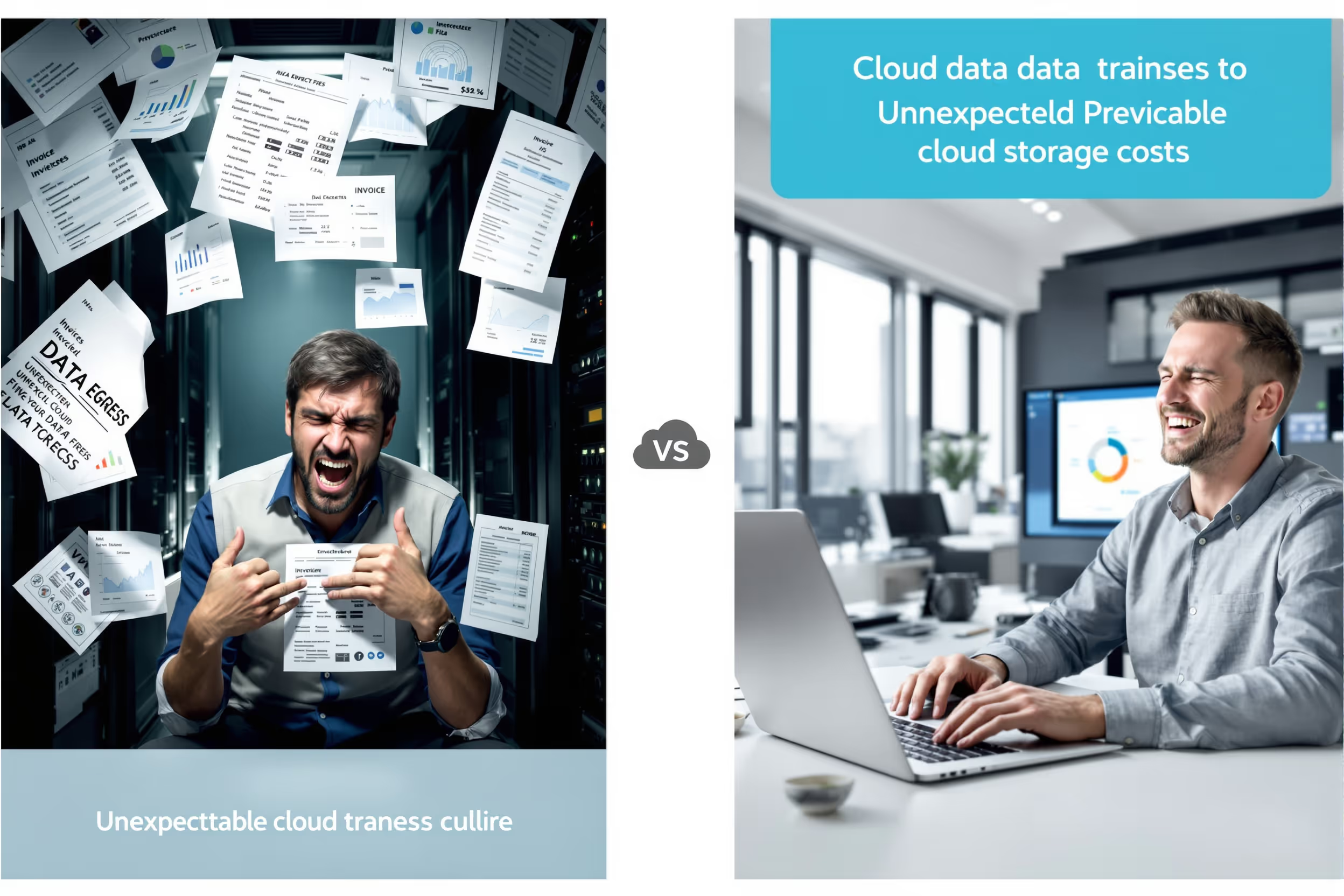
For most enterprises, cloud storage bills are a source of constant frustration. The #1 issue is cost unpredictability, driven by egress fees and API charges that can inflate total costs by 3-5x over the storage itself. This vendor lock-in creates significant strategic risk, making it prohibitively expensive to switch providers or retrieve your own data. The solution lies in a transparent, S3-compatible storage architecture designed for cost control. By eliminating egress fees and API call charges, businesses can achieve predictable billing and save up to 80% on typical cloud expenses, all while ensuring data control and ransomware protection.
Key Takeaways
- Eliminate egress fees and API call charges to reduce cloud data transfer costs by 60-80%.
- Use fully S3-compatible storage to ensure seamless migration of existing applications and backup tools without code rewrites.
- Leverage an 'Always-Hot' architecture with Immutable Object Lock to guarantee ransomware protection and instant data access without retrieval delays or fees.
Exposing the Hidden Drivers of Cloud Data Transfer Costs
Most enterprises find that data-intensive workloads generate unpredictable costs far exceeding the baseline price for storage. The primary culprits are egress fees, which can make up 10% to 15% of total cloud costs. These charges apply every time data is moved out of the provider's network, creating a financial penalty for data retrieval.
API call charges add another layer of complexity, penalizing routine operations and integrations. For backup and disaster recovery workflows, these combined expenses can inflate the total bill by 3-5x. This pricing model makes accurate budget forecasting nearly impossible for over 62% of IT leaders. This financial uncertainty is a direct result of pricing models that are intentionally opaque, creating a significant barrier to efficient cloud financial management.
Achieve up to 80% Cost Reduction with a Predictable Pricing Model
A predictable cloud cost model is built on transparency, eliminating the fees that cause budget overruns. The most effective way to reduce cloud data transfer costs is to select a storage provider with zero egress fees. This single change can result in 60-80% cost savings for backup and archiving use cases.
This model also removes charges for API calls and sets no minimum storage durations. Predictable pricing allows organizations to quote projects with confidence and protects partner margins from unexpected erosion. By moving to a flat-rate capacity model, businesses transform their cloud storage from a variable operational expense into a predictable, manageable line item. This approach provides a clear path to a lower total cost of ownership, as detailed in our S3-compatible storage TCO guide.
Ensure Seamless Migration with Full S3 Compatibility
True cost savings are only realized if the migration from a hyperscaler is seamless and requires zero code rewrites. Full S3 API compatibility is the key, ensuring that all existing applications, scripts, and backup tools continue to work without modification. This drop-in replacement capability reduces migration risk by over 90%.
An effective S3-compatible alternative must support advanced capabilities beyond basic object operations. The following features are essential for enterprise workloads:
- Versioning and lifecycle management policies.
- Immutable Storage with Object Lock for ransomware protection.
- Fine-grained Identity and Access Management (IAM) with MFA/RBAC.
- Support for existing SDKs and CLI tools without feature gaps.
This level of compatibility protects past technology investments and accelerates time-to-value by a factor of 10. A truly compatible platform means you only change the endpoint, keeping everything else the same, which is critical for predictable enterprise billing.
Leverage an 'Always-Hot' Architecture for Superior Performance
Traditional cloud storage often relies on complex tiering, which introduces delays and hidden fees for data retrieval. An 'Always-Hot' object storage model eliminates this complexity, ensuring all data is immediately accessible with no restore delays. This architecture delivers up to 20% faster backup performance with consistent low latency.
This model avoids fragile tiering policies that frequently lead to API timeouts and lifecycle policy drift. By keeping all data in a single, high-performance tier, organizations simplify operations and strengthen recovery capabilities. For businesses with mixed workloads, including millions of small files and large archives, this consistency is critical for maintaining application stability. Learn more about storage without hidden charges in our guide to archiving without retrieval fees.
Implement Non-Negotiable Ransomware Protection
Ransomware attacks increasingly target backup infrastructure, making immutable storage a mission-critical defense. Immutable Storage, or Object Lock, prevents data from being altered or deleted for a defined period. This capability is now a standard compliance requirement for many cyber insurance policies.
A robust security posture requires a multi-layered approach. Key security and compliance features include:
- Immutable Storage / Object Lock: Creates a tamper-proof copy of your data for guaranteed recovery.
- Multi-Layer Encryption: Protects data both in-transit and at-rest.
- IAM with MFA/RBAC: Enforces granular, role-driven access policies.
- SOC 2 and ISO 27001 Certifications: Verifies enterprise-grade security for regulated workloads.
These features provide a resilient defense against modern threats while ensuring data control and independence.
Empower MSPs with a Margin-Driven Partner Model
For Managed Service Providers (MSPs), predictable costs are the foundation of profitable service offerings. A storage model with zero egress or API fees allows MSPs to build high-margin Backup-as-a-Service (BaaS) and DRaaS solutions. This predictability means partners can quote with confidence, eliminating the risk of margin erosion from surprise bills.
The ability to launch a white-labeled, branded cloud service shifts the dynamic from reselling to owning an asset. This approach provides full brand and margin control, a key competitive advantage. With multi-tenant management, API-driven automation, and a dedicated partner console, MSPs can onboard clients in under 24 hours. This efficiency enables partners to pass savings to customers while increasing profitability on existing contracts by at least 15%.
Build a Lasting Exit Strategy to Avoid Vendor Lock-In
Vendor lock-in is a top concern for over 70% of enterprise IT leaders, as proprietary APIs and punitive egress fees make switching providers too expensive. An effective exit strategy is built into the storage architecture from day one. The combination of S3-compatible APIs and a zero-egress-fee policy provides the ultimate freedom.
This design preserves long-term negotiation power and freedom of action. Data portability is guaranteed through open standards and proven bulk data movement tools. By choosing a platform that is cost-efficient by design, organizations can break free from vendor lock-in and maintain full control over their data and their budget. This is a core principle when comparing costs, such as in a 1PB storage cost analysis.
More Links
The Federal Statistical Office (U.S. Census Bureau) provides a press release with statistical data relevant to the United States.
BearingPoint presents a study on how public authorities can achieve significant cost savings through cloud computing.
U.S. Government Accountability Office (GAO) offers a press release detailing federal spending on digitization for the first time.
CompTIA publishes a press release highlighting how companies are advancing digitization with cloud technology.
Wall Street Journal features an article discussing strategies for effective cloud cost management.
The Federal Ministry for Economic Affairs and Energy provides its Digital Strategy 2025 in a PDF document.
Grant Thornton shares an article on managing cloud costs through assessment for improved efficiency and transparency.
Statista offers a comprehensive topic page on cloud computing, including relevant statistics and data.
.avif)


.svg)


%201.avif)


.svg)