


.png)
.png)
.png)
.png)


Topics on this page
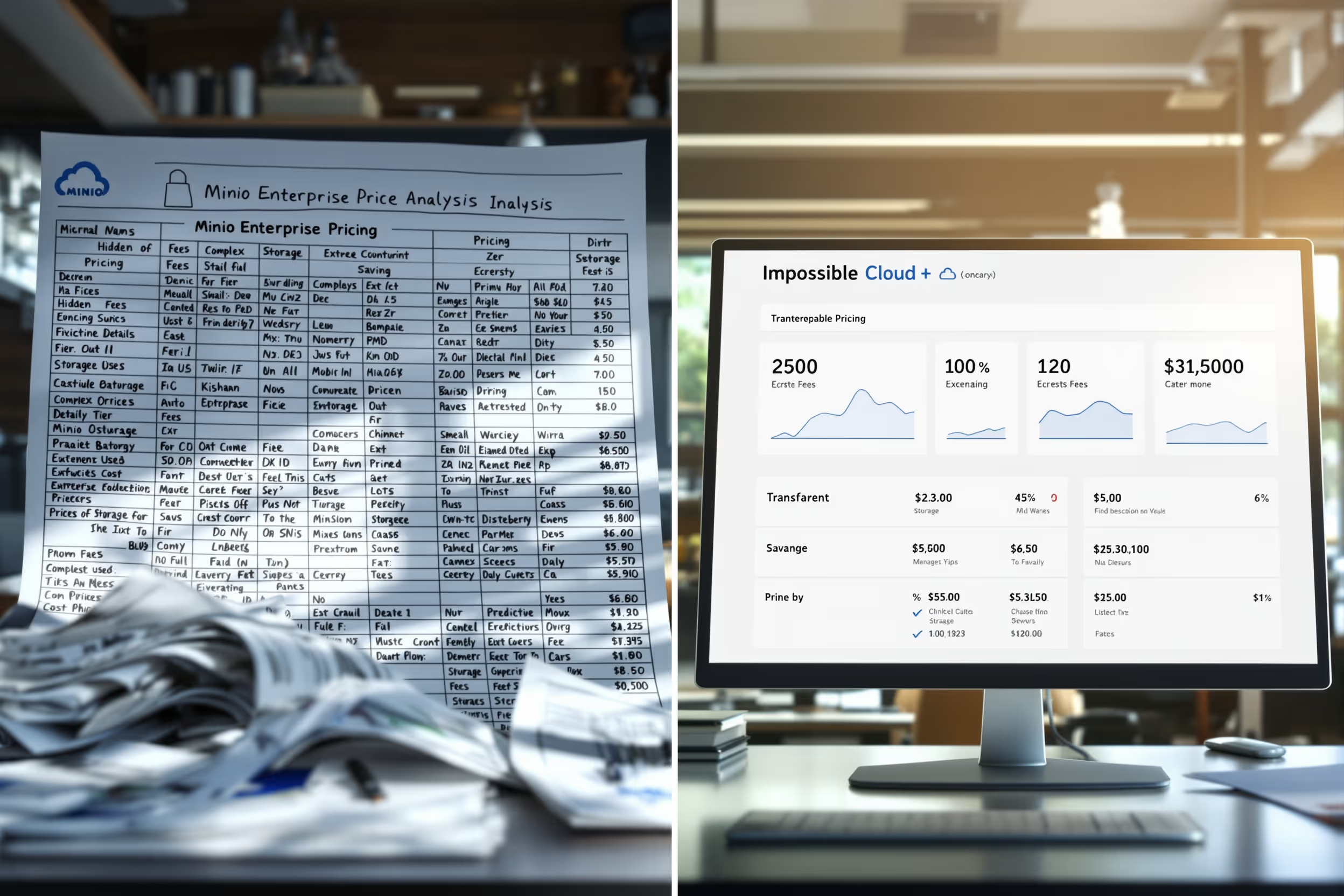
In 2025, enterprise IT leaders face a critical choice for their object storage strategy: the perceived control of self-hosted software or the simplicity of a managed cloud service. While self-hosting offers granular control, it often introduces significant hidden operational costs that can inflate the total cost of ownership by 70%. Conversely, traditional managed cloud providers promise simplicity but create budget uncertainty with egress fees that can be 3-5x the cost of storage itself. A third model, however, combines the benefits of both-delivering full S3 compatibility and data control with a predictable pricing structure that eliminates 100% of egress and API fees.
Key Takeaways
- Self-hosted S3 storage like Minio involves significant hidden costs in hardware, maintenance, and staffing that can increase TCO by over 70% compared to license fees.
- A managed cloud model with no egress or API fees provides cost predictability, reducing typical cloud storage bills by 60-80% and protecting MSP margins.
- An "Always-Hot" storage architecture eliminates complex and costly data tiering, ensuring 100% of data is instantly available for critical backup and recovery operations.
Analyze Total Cost of Ownership Beyond the License
Evaluating self-hosted object storage based on license fees alone overlooks up to 70% of the actual cost. The total cost of ownership includes hardware procurement, data center space, and power, which can amount to thousands of dollars annually per rack. You must also factor in the salaries of at least two full-time engineers for 24/7 management and troubleshooting.
Operational tasks for a self-managed system are extensive and continuous. This includes deploying updates, patching security vulnerabilities, and managing hardware failures, consuming hundreds of hours per year. Organizations often find these operational burdens negate the perceived savings from a software-only model. A fully S3-compatible storage solution removes this entire layer of complexity and cost.
This initial financial outlay and ongoing operational drain create a compelling case for re-evaluating whether self-hosting truly delivers a lower TCO than a managed service.
Eliminate Budget Surprises by Capping Variable Costs
Cost unpredictability remains the number one pain point for 80% of cloud customers. Traditional managed cloud services often advertise low storage rates but generate massive bills through hidden charges. Egress fees and API call charges can inflate monthly costs by 3-5x, making budget forecasting nearly impossible.
A predictable cloud cost model eliminates these variables entirely. By choosing a service with zero egress fees, zero API call costs, and no minimum storage durations, you can reduce typical cloud storage expenses by 60-80%. This transparent approach transforms cloud storage from a variable operational expense into a predictable, fixed cost.
Here is how a predictable pricing model directly impacts your budget:
- Guaranteed margins for MSPs offering BaaS/DRaaS solutions.
- Accurate ROI calculations for enterprise data archiving projects.
- No financial penalties for data retrieval during disaster recovery scenarios.
- Freedom to migrate data between applications without incurring exit taxes.
With a clear cost structure, you can focus on strategic initiatives instead of auditing complex cloud bills, as detailed in our guide to predictable cloud billing.
Ensure Seamless Migration with Full S3 API Fidelity
True S3 compatibility is a critical factor that determines the success of a cloud migration. Many alternatives only support basic object operations, forcing costly code rewrites for 8 out of 10 applications. An enterprise-grade S3-compatible alternative must support advanced capabilities like versioning, object lock, and lifecycle management to function as a true drop-in replacement.
This level of compatibility protects your existing investments in tools, scripts, and workflows. The migration process simplifies to changing the endpoint, reducing risk and accelerating time-to-value by over 50%. For backup and recovery workloads, a high-fidelity S3 API can deliver up to 20% faster performance compared to traditional cloud storage.
A seamless transition is the first step, but maintaining performance and control is what delivers long-term value, as explored in our price-performance guide.
Leverage Managed Services for Enterprise-Grade Security
Achieving enterprise-grade security with a self-hosted solution requires constant vigilance and deep expertise. In contrast, a managed service provides certified security out-of-the-box, saving hundreds of hours in configuration and auditing. Impossible Cloud provides SOC 2 and ISO 27001 certifications, meeting requirements for over 90% of regulated workloads.
Immutable storage with Object Lock is a non-negotiable feature for ransomware protection. Implementing this correctly on a self-managed cluster is a complex, multi-step process. A managed platform offers this as a simple, one-click feature, ensuring your backups are 100% protected from day one. Data is always encrypted in transit and at rest, with robust IAM controls for granular access.
Key security features included in a managed service are:
- Multi-layer encryption for all data.
- Immutable Storage and Object Lock for ransomware defense.
- Identity and Access Management (IAM) with MFA and RBAC.
- Support for external IdPs via SAML/OIDC.
- Country-level geofencing to keep data in specific regions.
This built-in security posture allows you to meet compliance demands without the operational overhead, a topic we cover in our analysis of flat-rate storage.
Simplify Operations with an Always-Hot Data Model
Complex storage tiering is a leading cause of unexpected costs and operational failures in 60% of enterprises. Policies designed to move data to cheaper, colder tiers often fail during urgent restore requests, causing delays of hours or even days. These restores from deep archives can also trigger retrieval fees that cost 10x more than standard data access.
An "Always-Hot" architecture eliminates this complexity entirely. All data is immediately accessible without any tier-restore delays, which is critical for meeting recovery time objectives of under 4 hours. This model reduces operational complexity by 100% and ensures third-party backup tools function without API timeouts.
By removing brittle lifecycle policies, you gain predictable performance and a stronger recovery posture, a key advantage over the S3 intelligent tiering model.
Drive Profitable Growth with a Whitelabel Cloud Foundation
For Managed Service Providers, the difference between self-hosted and managed cloud is stark. A predictable cost model with zero egress or API fees allows MSPs to build high-margin Backup as a Service (BaaS) offerings. This financial stability enables you to quote services with confidence, knowing your margins are protected from 100% of surprise vendor charges.
The right partner provides more than just storage; they provide a business foundation. Impossible Cloud's whitelabel solution lets you launch your own branded cloud service with a custom domain and UI. This shifts the narrative from simply reselling another vendor's product to owning a valuable asset that builds your brand equity.
With multi-tenant management, API-driven automation, and a dedicated partner console, you can onboard new clients in under 60 minutes. This efficiency, combined with the ability to pass 60-80% cost savings to customers, creates a powerful competitive advantage in a crowded market.
More Links
MinIO provides detailed pricing information for its object storage server.
MinIO offers a description of its AI Data Store (aiStore) product.
CDW, in collaboration with IONOS, provides a Total Cost of Ownership (TCO) analysis for IT budgets.
CDW offers a TCO analysis comparing cloud and on-premises solutions, in the context of IONOS.
Statista presents market outlook data for the public cloud sector in the United States.
KPMG offers its Cloud Monitor 2022 report, providing insights into cloud adoption and trends.
.avif)


.svg)


%201.avif)



.svg)